Living Between War and Peace:
The Human Experience of Uncertainty
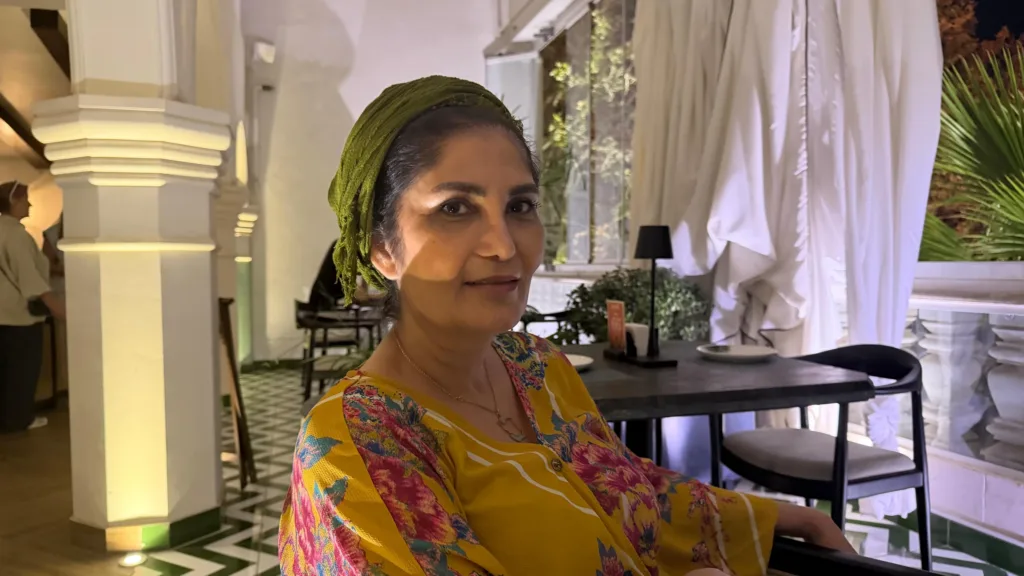
By Leila Zand, Co-Chair
FOR-USA National Council
I am in Iran, and I find myself struggling to identify the appropriate language for what I am witnessing.
Iran is at war, and yet, in many ways, it feels as though there is no war.
This is not a contradiction I can easily resolve. It is, rather, the defining characteristic of the moment: a society living with the psychological and political reality of war while simultaneously attempting to preserve the routines, relationships, pleasures, and aspirations of ordinary life.
I remember the eight years of the Iran-Iraq War. Even as a child, I understood that the country was at war. Bombs and missiles were part of everyday reality. Even when Tehran was not directly under attack, the war was constantly present through news reports from the borders and through the stories carried into our homes. War was not merely something happening elsewhere; it constituted the atmosphere in which people lived. It shaped daily behavior, conversations, fears, and expectations of the future.
What I am experiencing now is different.
The physical manifestations of war may not always be visible in the streets, but its psychological presence is unmistakable. People live with the knowledge that circumstances can change rapidly and that what appears calm today may not remain so tomorrow. Those who have lived through decades of political conflict, economic hardship, sanctions, and previous wars carry not only their own memories but also a collective memory of uncertainty.
There is, therefore, a peculiar form of normalization taking place. People are not necessarily calm because they believe everything is safe. Rather, they have learned to continue living in conditions in which safety can never be assumed.
This is particularly evident in the lives of children.
One of the encounters that has stayed with me most strongly was a conversation with a 12-year-old girl. She spoke with tremendous pride about being Iranian. She was proud of what she understood as her country’s ability to confront some of the world’s most powerful states, and she described Iran’s response with a sense of courage and national dignity.
But beneath that pride was fear.
She had asked her father to leave the large city and take her somewhere smaller because she was afraid of war.
What struck me most profoundly was not simply her fear, but the sophistication of her knowledge about violence. She knew about drones, missiles, ammunition, military intervention, and geopolitical confrontation.
A child should certainly be allowed to understand the world around her. But there is something deeply unsettling about a 12-year-old possessing such an intimate vocabulary of warfare. Her intellectual and emotional universe should have far more space for softer and diligent words than war. Instead, the language of military conflict has entered her childhood.
Instead, the language of military conflict has entered childhood.
This is one of the less visible consequences of war. A child does not have to stand on a battlefield for war to shape her life. It can enter through television screens, conversations between adults, social media, school discussions, family anxieties, and the emotional atmosphere of an entire society. It can become part of a child’s imagination long before it becomes part of her physical experience.
And yet, this is only one part of what I see.
I see fear, anger, frustration, economic hardship, and uncertainty. But alongside them, I also see an extraordinary insistence on life.
I hear laughter everywhere.
I see parents shopping for their children and preparing them for school. I see people buying clothes and school supplies. I see young people meeting friends. I see restaurants and cafés open late into the night. In Tehran, and from what I hear from other major cities, people continue to gather in cafés and restaurants, sometimes until four in the morning.
They eat. They talk. They laugh. They make plans.
None of this means that people are not suffering. The economic pressures are severe, and many people are carrying enormous burdens. Nor does the continuation of ordinary life mean that people have become indifferent to the possibility of violence.
It reveals something more complicated: the capacity of human beings to hold contradictory emotions simultaneously.
The cities carry a profound sense of loss. This year, 168 children will not return to school. Their absence will be experienced not as an abstract statistic, but through empty chairs, grieving families, interrupted futures, and the silence left behind by children who should have been preparing for another ordinary school year.
And yet, other children are preparing their backpacks with excitement.
Both realities exist at the same time.
Too often, societies experiencing conflict are represented through a single emotional vocabulary: fear, suffering, victimhood, anger, resistance, or despair. But real human beings rarely experience history so neatly. They grieve and laugh. They fear and celebrate. They mourn the dead while caring for the living. They worry about tomorrow while making plans for next year.
The human response to conflict is not linear. It is layered, contradictory, and profoundly ordinary.
Perhaps this is what I mean when I say that I feel like a full human being here. I am not encountering Iran through a single political narrative or a single emotional category. I am experiencing the multiplicity of human life in a society living under extraordinary pressure.
I can feel fear alongside pride, anger alongside tenderness, and grief alongside laughter. I see uncertainty, but I also see people planning for the future.
This complexity matters because political narratives can flatten human beings. They can transform societies into statistics, governments into countries, conflicts into binaries, and civilians into passive objects of history.
But ordinary life resists this simplification.
A country is not only its government, its military, its economy, or its geopolitical conflicts. It is also the mother buying a school uniform for her child. It is the father answering his daughter’s questions about war. It is young people sitting together in a café at midnight. It is laughter in a city living with uncertainty. It is the person making plans for next month despite not knowing what next week will bring.
These ordinary acts may be understood as forms of human agency. To continue living, gathering, loving, celebrating, studying, working, and imagining a future under conditions of uncertainty is not necessarily an indication that people have forgotten the danger around them. It can instead be understood as a refusal to allow conflict to define the entirety of human existence.
Perhaps this is the most important thing I am learning from being here.
War does not only destroy buildings, economies, institutions, and lives. It can also occupy the human imagination, narrowing the horizon of what people believe is possible and making the future itself feel uncertain.
And yet, people continue to imagine.
They continue to plan.
They continue to love.
They continue to live.
I am witnessing a society living beneath the shadow of war without allowing that shadow to swallow its ordinary humanity.
I see fear, anger, and loss woven into daily life. But I also see laughter rising in crowded cafés, tenderness between parents and children, friendships sustained through uncertainty, and hope quietly taking root in the midst of grief. People know that tomorrow may bring danger, absence, or sorrow, and still they make plans for it. They buy school supplies, arrange meetings, celebrate birthdays, and imagine futures they cannot be sure they will reach.
Perhaps this is not denial. Perhaps it is resilience: the decision to keep loving, gathering, laughing, and dreaming while knowing how fragile life can be.
It is the refusal to let war become the only language of existence—the insistence that even under its shadow, life must still be lived.
The Fellowship of Reconciliation-USA is part of the United for a Just Peace coalition, initiated by National Iranian American Council (NIAC) Action, Action Corps, CODEPINK, Bring Our Troops Home, Common Defense, The Libertarian Institute, Peace Action, World BEYOND War, MPower Change, and Presbyterian Church (USA) Office of Public Witness, among other groups.
This coalition was inspired, in part, by FOR-USA National Council Co-Chair Leila Zand’s actions at the U.S. Capitol interrupting Congressional hearings with Secretary of War Pete Hegseth. The coalition recently participated in protests to demilitarize the Brookly Navy Yard and organized a series of actions in Washington, D.C. on September 15, the 25th Anniversary of the post-9/11 Authorization for Use of Military Force by Congress—the “legal” basis for the U.S. forever wars.
FOR-USA members and chapters are encouraged to read the coalition’s joint statement and participate in nationwide rallies at your nearest congressional district office on October 20 by signing up here and reviewing the growing list of local actions.
Please also ask other organizations of peace and justice you are a part of to endorse the upcoming actions here and join the United for a Just Peace coalition here. If you have any questions about these upcoming rallies or the wider coalition, please visit: https://niacouncil.org/stopiranwar.