Immigration Justice Through a Christian Lens:
Healing a Broken World Through a Choir of Nonviolent Resistance
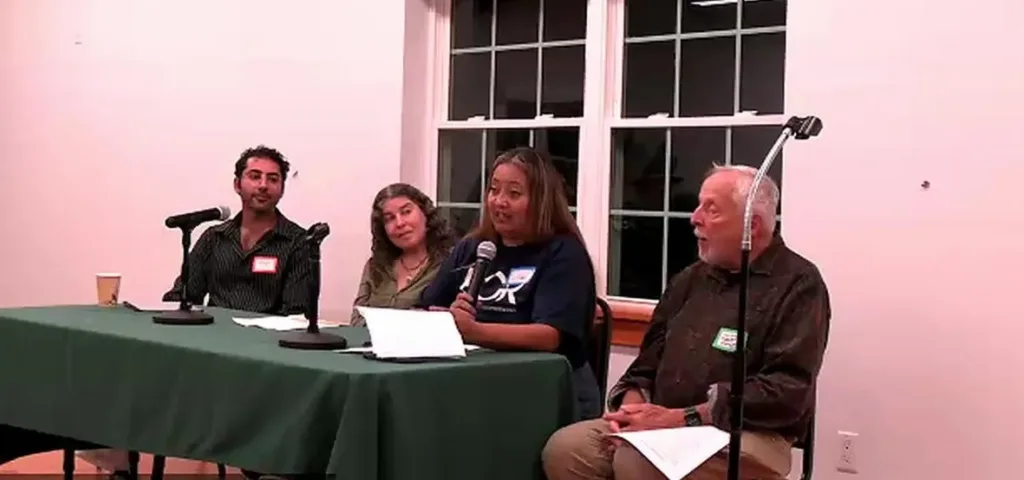
By Dr. Linda Alvarado-Arce
Interum Co-Executive Director, FOR-USA
Is disrespect the new cultural norm? I have been asking myself that question a lot lately. Over the past week and months, I have witnessed things that have made me stop, think, and ask:
Is this really who we are becoming?
I have witnessed violence in my own community. I have felt pepper spray on my face while standing in a place where people were exercising their right to speak and protest. And I have watched innocent people—people who want a better life for themselves and their families, as each of us does—being detained, separated, and treated as though their humanity is somehow negotiable. And I have heard people use laws, amendments, court challenges, and changes in our society to justify things that, at their core, reveal racism, xenophobia, and fear.
And I ask:
Have we always been this way? Or have we simply reached a moment when people feel free enough to say out loud what they once kept hidden?
I don’t know.
But I do know this:
I cannot simply watch, and my Christianity has something to do with that.
My faith has taught me that I cannot separate what I believe from how I treat people.
Jesus said, “I was a stranger, and you welcomed me.”
That is not a political statement to me. It is a spiritual responsibility.
And when I look at immigrants—when I look at my Latinx community—I don’t see a political issue. I see people. People like [FOR’s Walter and June Keene Wink Fellow] Mohsen [Mahdawi].
I see families.
I see parents trying to protect their children.
I see people working, studying, building businesses, worshiping, raising families, contributing, and trying to create a better life.
And I see people who deserve the same dignity, opportunity, and humanity that we all want for ourselves and for our families.
If you know me, know my work, or have heard me speak, you may think I have been preaching to the choir. And, well— I have been. And it has been intentional.
Everything I say, everything I have said, everything I do, and everything I continue to do has been intentional and specific.
And for one reason:
So, my people—my raza—can be heard!
So that the plight of my Latinx people today, yesterday, and tomorrow can be remembered, loved, cherished, and understood.
But I didn’t arrive here overnight. It took me a long time to understand where my energy belonged. For years, I was everywhere. I was on this board, that committee, doing this job, advocating for this person, fighting for that issue.
Every sad story I heard, every phone call I received from someone in need, every person who knew a person in need—I wanted to fix it. Moving from one fire to the next. Until I learned something very important:
If you try to do everything, you eventually become effective at very little.
A former colleague once told me that if we really want to make an impact, we can’t stretch ourselves too thin. We need to pick one—or perhaps three—things to which you can truly give yourself.
So, I made a vow to myself that I would invest my time, my energy, my body, my resources, my voice, and my spirit into the things I believe matter.
One of those things is creating a “beloved community” through the Fellowship of Reconciliation—and through peaceful and nonviolent means.
Another is walking in my feminism and bringing other women with me.
And yet another is making sure my Latinx raza and familia have the opportunity, protection, education, and voice that every community deserves.
Therefore, on January 22nd of this year, I found myself standing outside in Oregon, Ohio, at a protest connected to Vice President J.D. Vance’s visit to one of our oil refineries. It was cold. Twenty degrees, and the streets were covered in snow. The police had blocked the streets, creating a barrier between the protesters and the refinery parking lot. And I was bundled up, standing there with everyone else, chanting, holding signs, speaking out for immigrants, and protesting injustices and wars. And a woman pulled up in her car. And she asked me, “Is this because J.D. Vance is in town?” I said yes. She smiled, and she said: “I want to be part of the protest. I’ve never done that before. And it’s cold outside—but I don’t care. I still want to do it.”
And something about that moment stayed with me. Because I understood her.I remembered being young. I remembered my parents taking me to see, hear, and march for migrant farmworker rights with César Chávez in Toledo, Ohio. I remember that bright red strip of material tied around our arms, our foreheads, our hats. The black eagle. I remember the red flags.
I remember watching people come together because they believed that something had to change. And now… years later… I was watching another person take those first steps into activism.
I realized that day that: Movements are not made only by leaders.
They are made by people who decide to show up. People who decide to use their free time. Their bodies. Their voices. Their positionality. Their privilege. Their discomfort. Their faith. And, their courage. To stand beside people who may not look like them, sound like them, worship like them, or come from the same place. And this brings me to the metaphor I have come to love:
The choir.
Because when you walk into a protest, everyone has a position. Some people lead. Some organize. Some speak into the megaphone. Some make the signs. Some sing. Some play instruments. Some work behind the scenes. And some people—many, many people—are simply the bodies that show up. They bring the energy.
They bring the comadres and the compadres.
They create the movement.
And every one of them matters.
The same is true in our work for justice.
You don’t have to be me. You don’t have to be a preacher, a pastor, or a religious leader. You don’t even have to be an organizer or stand behind a microphone. AND- You definitely don’t have to know exactly what to do.
What you do need to do is “find your position, your passion.”
Maybe you’re a soprano, an alto, a tenor? Maybe you’re still trying to figure out what your voice sounds like. And that’s okay.
Just find your position.
Because nonviolence does not mean silence. Nonviolence does not mean surrender. Nonviolence means that we choose how we want to resist.
We choose not to answer hatred with hatred. We choose not to answer violence with violence. We choose courage, conscience, community, and to stand together, and with, and for others. And for me, that is where my Christianity, my Latinx identity, my activism, and my commitment to nonviolence all come together.
Because, my faith tells me to “welcome the stranger.” My history tells me to “remember those who stood before me in this fight for justice and dignity.” My community tells me not to forget my people. And my conscience tells me: Don’t just stand by and do nothing.
So today, I am not asking you to become me.
I am asking you to find your position, your voice, your people. Find the place where your faith, your values, your experience, and your passion intersect. And then just SING.
Sing for the stranger, the immigrant, the vulnerable… Sing for those whose voices have been silenced. Sing for those who cannot be in the room.And, more importantly, sing for justice, peace, and reconciliation. And when you don’t know what part to sing, listen for someone else who just needs you to stand beside them.
Because a choir doesn’t need everyone to sing the same note. It just needs every voice.
And right now, in this moment, with so much division, fear, disrespect, and unrest around us—
I believe it is time for all of us to sing in one accord.
It is time for the choir of nonviolent resistance to sing and to sing loudly. And most importantly—it is time for us to be heard.
So, today, I thank you all for being here, listening to me, and for joining the FOR-USA in creating a BELOVED COMMUNITY.
These remarks were delivered by FOR-USA Co-Interium Executive Director Dr. Linda Alvardo-Arce at the recent FOR Metro NY/NJ Chapter gathering on October 8, 2026.