FOR Email Updates

Sign up for email updates: Optional Member Code

The Rebel Passion: Eighty-five Years of the Fellowship of Reconciliation


In his introduction to Euripedes' The Trojan Women, Gilbert Murray writes of pity as the "rebel passion. Its hand is against the strong, against the organized force of society, against conventional sanctions and accepted Gods. It is the Kingdom of Heaven within us fighting against the brute powers of the world." From this idea, Vera Brittain took the title for her history of the FOR at the time of its fiftieth anniversary:The Rebel Passion.

It was such a passion that brought the Fellowship of Reconciliation into being in 1914. Convinced that war was near, some 150 Christians came together at an international conference in Germany, seeking desperately to find a way to head off the outbreak of hostilities. The conference ended in failure; indeed, the war broke out while the meeting was being held. The participants hurried to catch trains back to their respective homelands. At the Cologne rail station, two of the participants-Henry Hodgkin, British Quaker, and Friedrich Siegmund-Schultze, pacifist chaplain to the German Kaiser-believing that the bonds of Christian love transcended all national boundaries, vowed that they would refuse to sanction war or violence and that they would sow the seeds of peace and love no matter what the future might bring. As they shook hands in farewell, they agreed that they were "one in Christ and can never be at war."

Out of this vow the Fellowship of Reconciliation was born. The formal beginning came four months later at Trinity College, Cambridge, where 128 English members elected Hodgkin as their first chairperson. The founding of the German branch, Versuhnungsbund, came later. Schultze was arrested twenty-seven times during World War I and was forced to live in exile during the Nazi period.

In 1915, Hodgkin came to the United States to meet with sixty-eight men and women at Garden City, New York where the American FOR was founded on November 11, with Gilbert A. Beaver as its first chairperson. Leaders during those early years included Edward Evans, Norman Thomas, Bishop Paul Jones (who had been removed from the Episcopal Diocese of Utah because of his pacifism), and Grace Hutchins. John Haynes Holmes, Unitarian minister and one of the early FOR members pointed out that most people believe war is wrong in general, but nonetheless go on to justify each particular war. Placing the claims of the nation state below that of religious faith, Holmes wrote: "No one is wise enough, no nation is important enough, no human interest is precious enough, to justify the wholesale destruction and murder which constitute the science of war."

Members of the Fellowship bore gallant witness to the insanity of war and the belief that truth is stronger than falsehood, that love overcomes hate, and that nonviolence is more enduring than violence. For them, religious faith broke down the barriers of nation and race, class and tradition. Spreading this vision, even in wartime, has remained the central witness of the Fellowship.

A major focus has been working for the rights of conscientious objectors, who were treated harshly during the first World War. Except for those from the historic peace churches(who usually were granted CO status), many were imprisoned, left without clothes in cold cells, firehosed and manacled in their cells.

Prison sentences ranged from twenty-five years to life !

John Nevin Sayre, American churchman and early chair of the FOR, went directly to President Wilson to protest the inhumane treatment and the torture was ended. After extensive lobbying by FOR and others, concessions were made that led finally to legal recognition of conscientious objection during World War II. In that war, more than 16,000 men performed "work of national importance" in public service camps. Some, however, still went to prison when their beliefs clashed with Selective Service rules. These included five FOR staff members: Roger Axford, Caleb Foote, Alfred Hassler, Bayard Rustin and Glenn Smiley.

While war has been the central social evil the FOR has sought to eradicate, an expanding social vision has moved the Fellowship into other critical areas needing the work of reconciliation and the establishment of justice. In 1918, it helped found Brookwood Labor College. In 1919, A.J.Muste, who was then head of the Boston FOR, rose to prominence during the textile strike in Lawrence, Massachusetts, where the power of nonviolent action was effectively demonstrated.

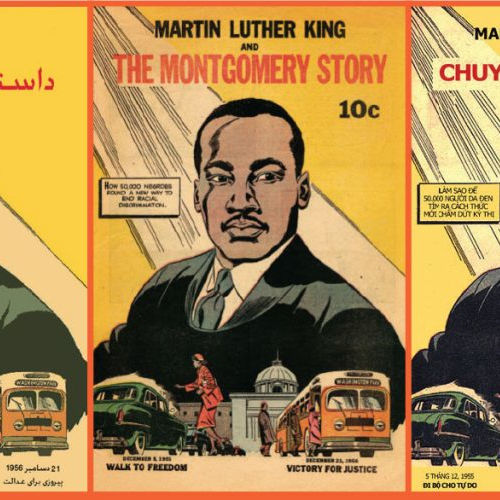
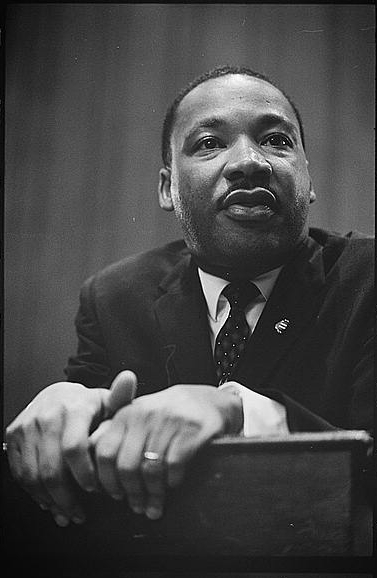
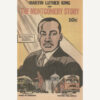
Another area of enduring FOR concern has been to eradicate the evil of racism and to build what Martin Luther King, Jr. called "the Beloved Community." Years before there was a civil rights movement, the FOR was active in this effort. With the Congress of Racial Equality (CORE), FOR sponsored the first interracial sit-in, in 1943. As a consequence of its interracial Journey of Reconciliation through the South in 1947, FOR race relations secretaries received the Jefferson Award of the Council Against Intolerance. FOR was instrumental in ending segregation in public facilities in such cities as Denver and Washington, D.C. and in 1957, staff member Glenn Smiley worked beside Martin Luther King, Jr. in the decisive Montgomery bus boycott. Staff member James Lawson, based in Nashville led nonviolence trainings throughout the South that were of seminal importance to the civil rights movement. The FOR provided speakers in churches, synagogues and schools, held workshops, raised money for bombed churches and produced films and literature (including the film "Walk to Freedom" and the Martin Luther King Jr. comic book in English and Spanish) that were widely distributed across the country.

Alongside such efforts of the FOR in the United States, the work of the Fellowship was growing worldwide. The International FOR was established in 1919 to coordinate the new national chapters that were being formed. Its first secretary was Pierre Ceresole, the Swiss pacifist who was jailed time and again for his peace witness, and from whose vision and labors came the modern work camp movement. It first brought together volunteers from former enemy nations to undertake reconstruction projects in war-ravaged Europe. Relief for the victims of war was carried out, and international conferences and meetings spread the work of peace to many other parts of the globe. In 1932, the IFOR led a Youth Crusade across Europe in support of the Geneva World Disarmament Conference. Protestants and Catholics from all over converged on Geneva by various routes, reaching over 50,000 people and presenting to the Conference a petition calling for total disarmament among the nations. As the clouds of war gathered across Europe later in that decade, the IFOR established Embassies of Reconciliation that initiated peace efforts not only in Europe but in Japan and China as well.

"Ambassadors of Reconciliation," such as George Lansbury, Muriel Lester and Anne Seesholtz, visited many world leaders, including Hitler, Mussolini, Leon Blum and Roosevelt. Muriel Lester, English social worker, served as IFOR traveling secretary throughout the world, helping to establish its work in many countries. A stirring speaker and writer, she was a practical mystic who was equally at home holding a School of Prayer in Uruguay, working with Gandhi for India's independence, or fighting the drug trade in China. When World War II erupted, many European members of the FOR were in the front ranks of nonviolent resistance to totalitarianism and to all the dehumanizing aspects of the war. Many were imprisoned and scores were executed. Heroic efforts were undertaken to aid the victims of war.

Thousands of Jews and other refugees were successfully hidden and smuggled to safety, as in the south of France, where Andre and Magda Trocme led the villagers of Le Chambon to establish a haven in the midst of Nazi and Vichy terror. Even in Germany itself, members of the Versohnungsbund, like Heinz Kloppenburg, Irmgard Schuchardt and Martin Nieomuller were active in the nonviolent resistance to fascism.

In the United States, FOR took action when the US government ordered Japanese-Americans into internment camps in 1942. FOR held public protests of the action and extended concrete help to the victims (such as caring for the property of those forcibly evacuated). An FOR member, Gordon Hirabayashi, was the only Nisei to refuse to register for evacuation; his case went to the Supreme Court. FOR provided for visits to the camps and set up a travel loan fund to help resettle people after they were released from the relocation centers. The national office added a young Japanese-American to its staff to interpret to schools, churches and FOR groups what was happening to people of Japanese ancestry.

In 1944, the FOR published Vera Brittain's "Massacre by Bombing," a carefully documented study of the saturation bombing of Germany by the Allies. Signed by twenty-eight prominent American church leaders, the publication aroused international concern over the effects of obliteration bombing and heightened public awareness of the savagery of modern warfare. Bringing such information to the public has been one of FOR's main functions. Its first magazine, The World Tomorrow, was begun in 1918. By 1934, its circulation had risen to 40,000. Editors over the years included Norman Thomas, Devere Allen, Kirby Page and Reinhold Niebuhr. The World Tomorrow was succeeded in 1935 by Fellowship, edited by Harold Fey; later editors included John Nevin Sayre, Alfred Hassler, William Miller, James Forest, and Virginia Baron.

After World War II, there was a major effort to establish a year of permanent military training for all young men in the US, to be followed by seven years of reserve service. Under the leadership of John Swomley, FOR worked with a large coalition to form the National Council Against Conscription, which waged a successful campaign to defeat the proposal for Universal Military Training.

The end of World War II brought in its wake a new and unprecedented moral issue: nuclear weapons. From the dropping of the first atomic bombs on Hiroshima and Nagasaki, the FOR condemned nuclear weapons. In the 1950s, the FOR opposed atomic testing and sent a public statement to Japan expressing sorrow over the tragedy of fishermen who were radioactively burned by the Pacific bomb tests. It also spoke out against the civil defense program that conditioned people to be ready for still another war.

Members such as Dorothy Day and A.J. Muste refused to take shelter in New York City during air raid drills. Their repeated arrests for civil disobedience helped to build public awareness that there is no shelter from nuclear war. In 1995 FOR executive secretary Jo Becker led a delegation to Japan with a message of repentance for the atomic bombing of Hiroshima and Nagasaki that helped challenge anew the official US view of the necessity of those bombings.

FOR responded creatively to the fad for fallout shelters with its Shelters for the Shelterless campaign that built dwellings for homeless people in India. It also made the first proposal that American surplus food be sent to communist China. In 1954, the FOR launched a six-year Food for China Program in response to Chinese famine. Tens of thousands of miniature bags of grain were sent to President Eisenhower with the inscription, "If thine enemy hunger, feed him."

During this period, the witch hunts of Senator Joseph McCarthy intimidated many leaders. Communists and blacklisted persons were denied access to speaking platforms. FOR sponsored a public forum in which A.J.Muste and Norman Thomas debated two Communist leaders in a forceful and daring affirmation of free speech at Carnegie Hall in New York. In the 1960s the FOR formed the International Committee of Conscience on Vietnam, with 10,000 clergy in forty countries. Contact with the Vietnamese Buddhist pacifist movement was established, spearheaded by the untiring efforts of the US executive secretary, Alfred Hassler. In 1968, at the height of the suffering in Vietnam, FOR sponsored a world tour by Buddhist monk Thich Nhat Hanh, whose poetry and other writings, as well as his speeches and presence, made a profound impact wherever he went. FOR's "Meals of Reconciliation" raised money for medical aid for all areas of Vietnam. In 1969, the FOR Study Team on Religious and Political Freedom documented Saigon's reliance on torture and initiated a prodigious effort to gain the release of Vietnamese political prisoners, some of whom had been crippled for life. These various missions to Vietnam continued a tradition of FOR since its inception, in which missions of reconciliation and friendship have been sent to such places as the Philippines (1925), Haiti (1926), Central America (in the 1920s,1980s and 1990s), the USSR throughout the 1980s, Libya in 1989, Iraq and Israel/Palestine in the 1990s. After the Vietnamese war ended, a campaign for amnesty for US war resisters was launched, as well as a program to help support Vietnamese orphans. In 1970, Dai Dong was founded as a groundbreaking transnational project linking war, environmental problems, poverty and other social issues. Thousands of scientists around the world were reached through this program, as evidenced by the Menton Statement, signed by 2,200 biologists (including four Nobel Prize Laureates). The full statement, "A Message to our 3 1/2 Billion Neighbors on Planet Earth," was published in the UNESCO Courier and received worldwide attention. In 1972, in an effort to move public opinion beyond the constraints of national self-interest, Dai Dong sponsored an alternative environmental conference in Stockholm at the time of the UN Environmental Conference.

With the end of the Vietnam War, FOR placed major emphasis on ending the Cold War, reversing the arms race, meeting human needs and building global solidarity. FOR was part of a growing number of groups-peace, environmental, minority rights, women, anti-intervention-that worked for a more compassionate domestic and foreign policy. It joined in campaigns, marches, educational projects, and civil disobedience. At sessions of the World Council of Churches and the UN, FOR sponsored Plowshares Coffee Houses to provide an alternative forum for critical issues facing the world community.

In the 1980s, as the Cold War deepened, FOR launched a major emphasis on US-USSR Reconciliation to undergird its disarmament efforts and to root out the enemy image that had so poisoned East-West relations. Through people-to-people projects and exchanges, FOR made a significant contribution to the dramatic turnaround in US-Soviet relations that occurred in the late 1980s. FOR also pioneered in bringing nonviolence education and training to Russia and Lithuania as the Soviet Union broke up.

Recent years have seen the growth of IFOR branches and affiliates in Latin America, Asia, Africa, and the Middle East. The seeds planted earlier by traveling secretaries like Muriel Lester and John Nevin Sayre bore fruit, along with the decades of seminars in active nonviolence carried out by Jean and Hildegard Goss-Mayr of Paris and Vienna, three times nominated for the Nobel Peace Prize. From such labors arose Servicio Paz y Justicia (SERPAJ) throughout Latin America. SERPAJ's Adolfo Perez Esquivel of Argentina was awarded the Nobel Peace Prize in 1980. IFOR training in active nonviolence contributed significantly to the people power overthrow of the Marcos dictatorship in the Philippines in 1986, as well as the growth of nonviolent movements in Asia and Africa. The Goss-Mayrs, IFOR Honorary Presidents, were central to the global spread of active nonviolence.

FOR, under the work of executive secretary Doug Hostetter, made valiant efforts to stop the Gulf War through repeated delegations to Iraq that sought to keep open possibilities of a peaceful resolution of the crisis brought on by Iraq's invasion of Kuwait. After the war one million dollars in medical supplies were taken to victims of the war. Efforts to build peace with Iraq and to stop the sanctions that killed so many innocent Iraqis have continued through the 1990s.

In response to ethnic cleansing in the former Yugoslavia, FOR initiated the Bosnian Student Project to bring Bosnian students to the US for study due to the disruption of their lives by the war. This effort was matched by work camps for reconstruction and reconciliation in Bosnia.

Despite the end of the Cold War, the US military budget remained obscenely high, leading FOR to issue an Interfaith Call to Restore Sanity and Compassion to the National Agenda. FOR has also joined with other religious peace groups to foster a New Abolitionist Covenant to get rid of all nuclear weapons. FOR has placed special emphasis on youth through its Peacemaker Training Institute and its peace internships.

Also in this period FOR worked for racial and economic justice, especially for women of color in the workplace who so often work under dangerous and degrading conditions. There has also been a healing emphasis on racial dialogue and reconciliation in the U.S.

FOR's vigorous work in Latin America has been highlighted by its national leadership to ensure that the US fulfill its historic promise to decolonize and demilitarize the US presence in Panama and to faithfully comply with the Panama Canal Treaties. FOR joined with other groups to organize SIPAZ(International Service for Peace) to support a just and lasting peace in Chiapas.

With the assistance of FOR and its members, over the years a wide variety of parallel groups have come into existence: the American Civil Liberties Union, the National Conference of Christians and Jews, the Congress of Racial Equality, the Workers Defense League, the Committee for Social Responsibility in Science, the Committee on Militarism in Education, and the American Committee on Africa. Such organizations have taken up tasks in such specific fields as civil liberties or the support of African independence movements. The FOR has sought to remain on the cutting edge of nonviolent witness in each generation.

While the Fellowship has been religious in inspiration and outlook since its inception, the nature and dimensions of this commitment have broadened over the years. Founded by Christians, the Fellowship was at first centered in the ethic of love that Jesus taught, and this remains the faith of many FOR members. At the same time, the remarkable growth of nonviolent thought and life in the twentieth century has had a profound impact on the Fellowship. It was deeply affected by Gandhi and the freedom struggle in India, with its roots in the ancient teachings of Hinduism. Jews have brought to the FOR a commitment to nonviolence that grows out of Judaism's allegiance to universalism, justice and love. The powerful pacifist movement in Vietnam brought to the world's attention the great tradition of nonviolence that derives from Buddhism. One of IFOR's new Asian branches, in Bangladesh, includes many Muslims, as well as Hindus and Christians. Out of FOR's work against the Gulf War and the continuing sanctions in Iraq, FOR has joined increasingly with Muslims in peacemaking. The Muslim Peace Fellowship has become one of FOR's vital affiliates.

The FOR has seen these and other expressions of nonviolence as indications of an unfolding understanding of the meaning of truth and the way of love.

As a result, the FOR has become interfaith, and as such is a religious pioneer, pushing beyond contemporary ecumenism. It encourages people to live out the full dimensions of their beliefs, even as they are enriched and strengthened by traditions other than their own.

The FOR has fostered and encouraged peace fellowships within the various religious traditions and with these fellowships has often led the way in challenging (and assisting) established religious bodies to take up the peacemaking task, from combating homophobia and anti-Muslim prejudice to witnessing against handgun violence at home and support of dictatorial and exploitative regimes abroad.

As we enter the twenty-first century, the challenge to peacemakers continues, not only to rid the world of nuclear weapons and all weapons of mass destruction, but to remove the occasion for war, oppression and hostility between and within nations, and to build a just peace and to save the earth. Under the vigorous leadership of executive secretary John Dear (the first priest in that position) and its national chairperson, James Lawson, FOR called for a forty day People's Campaign for peace and justice in the summer of 2000 in Washington, DC

Throughout the world, people are showing their determination to be free and to be treated justly; they are learning the great power of nonviolent struggle, compassion and reconciliation, even in the face of seemingly overwhelming odds. The UN declaration of the first decade of the new millennium as a decade for a culture of peace and nonviolence is evidence of this hope.

The Fellowship of Reconciliation, with its message of peace and active nonviolence, grounded in faith and tested over many years, is uniquely equipped to speak to the present age and the universal longing for peace and justice.

©2001 Fellowship of Reconciliation

View more posts on:
HTML Site: 
Imported Content: