FOR Members

FOR Email Updates

Sign up for email updates:

Ethan Vesely-Flad's blog


A bonus for ending the war?

I am regularly reminded that humor is a relative concept: my idea of a funny twist on the political ills of the moment often offends the next person.

Ethan Vesely-Flad's picture

Resisting militarism in Korea

For the past several years, the people of Jeju Island, Korea have waged a nonviolent struggle against U.S. and Korean miitary forces. Since 2007, a proposed naval base has been the primary source of their courageous resistance, which has led to hundreds of arrests of community members and peace activists from across the Korean peninsula, supported by countless international allies.

FOR leader among 4 sentenced to jail in Syracuse

Last week, 31 peace activists were found guilty on two charges of disorderly conduct for their role in an April 22, 2011 protest at the Hancock Air National Guard Base in upstate New York.

Ethan Vesely-Flad's picture

PTSD and suicide: The military effects of a decade of war

This week I have seen numerous reasons cited for why our government should immediately end its military occupation in Afghanistan, many of which are financial.

Ethan Vesely-Flad's picture

Call for Submissions: Human Rights Accompaniment issue of Fellowship magazine

Fellowship magazine is issuing a call for submissions for its Fall 2011 issue, which will focus on the topic of human rights accompaniment.

What Is Pacifism Good For?

In yesterday’s “Sunday Review” section of The New York Times, Louisa Thomas penned an excellent op-ed titled “Give Pacifism a Chance.” Thomas is the great-granddaughter of Fellowship of Reconciliation early leader Norman Thomas, and recently published the critically-acclaimed Conscience: Two Soldiers, Two Pacifists, One Family — A Test of Will and Faith in World War 1, which was reviewed on this site in combination with an interview of the author by FOR Executive Director Mark Johnson.

Ethan Vesely-Flad's picture

Peaceful coexistence

Those of you following our Voices FOR Peace series on the Fellowship of Reconciliation Facebook page may recognize this quote from Margaret Mead: “Peace no longer is an unobtainable ideal but a necessary condition of continued human existence.”

With the violence in Norway directed squarely at interconnectedness and a diversity of cultures, and the upcoming observance of ten years following the September 11, 2001 attacks — and the United States’ responses — we are feeling this principle more than ever. We hope you will join us in this moment inexploring ways we can peacefully coexist — and work nonviolently on behalf of the peaceful coexistence of others.

Debt. Prison. What's next?

With the United States government just one week away from a historic default on its debt, President Obama and House Speaker Boehner are publicly trading salvos about the impending crisis.

Yesterday, meeting in Los Angeles, the NAACP passed a historic resolution calling for an end to the so-called “war on drugs,” weeks after a series of high-level reports (including a New York Times op-ed by former President Jimmy Carter) and called on the federal and state governments to end failed drug policies that have increased our prison population by 700% over a 35-year period.

What do these seemingly separate issues have in common? Answer: each was a central focus of the last two issues of Fellowship magazine, FOR’s national journal addressing peace, social justice, and nonviolence since 1918.

If you’re not a current subscriber, subscribe to Fellowship magazine today!

Why Do the Pentagon Papers Matter Now?

On the 40th anniversary of the Pentagon Papers release last month, Daniel Ellsberg published an essay, “Why the Pentagon Papers Matter Now.” We think Ellsberg’s thoughts have real relevance and are provocative, especially in the age of WikiLeaks. What do you think? Why do the Pentagon Papers matter now? The producers of the recent Academy-Award and Emmy-nominated documentary The Most Dangerous Man in America: Daniel Ellsberg and the Pentagon Papers have launched an online dialogue, called “The ‘Most Dangerous’ Wall”.

They invite you to post your thoughtful, personal comments, video, audio or photos. Share your ideas and respond to others. In appreciation to those who “get the dialogue going,” the producers will a premium to the first 100 people who post to the site: posters may select their offering, including a gift to FOR.

1958 MLK comic book republished by FOR

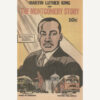
This week, two PBS television specials feature a 50-year-old comic book created by the Fellowship of Reconciliation. This exciting story ties FOR’s civil rights legacy to today’s ongoing work for nonviolence action around the world, and you can not only watch the TV specials but also purchase a copy of this historic resource.

First published by FOR in 1958, Martin Luther King and the Montgomery Story made news headlines earlier this year due to its translation into Arabic by a young Egyptian human rights activist, Dalia Ziada. Her story was profiled last night on PBS’s NewsHour program in a compelling interview with journalist and Middle East analyst Robin Wright, who held aloft the comic book.